
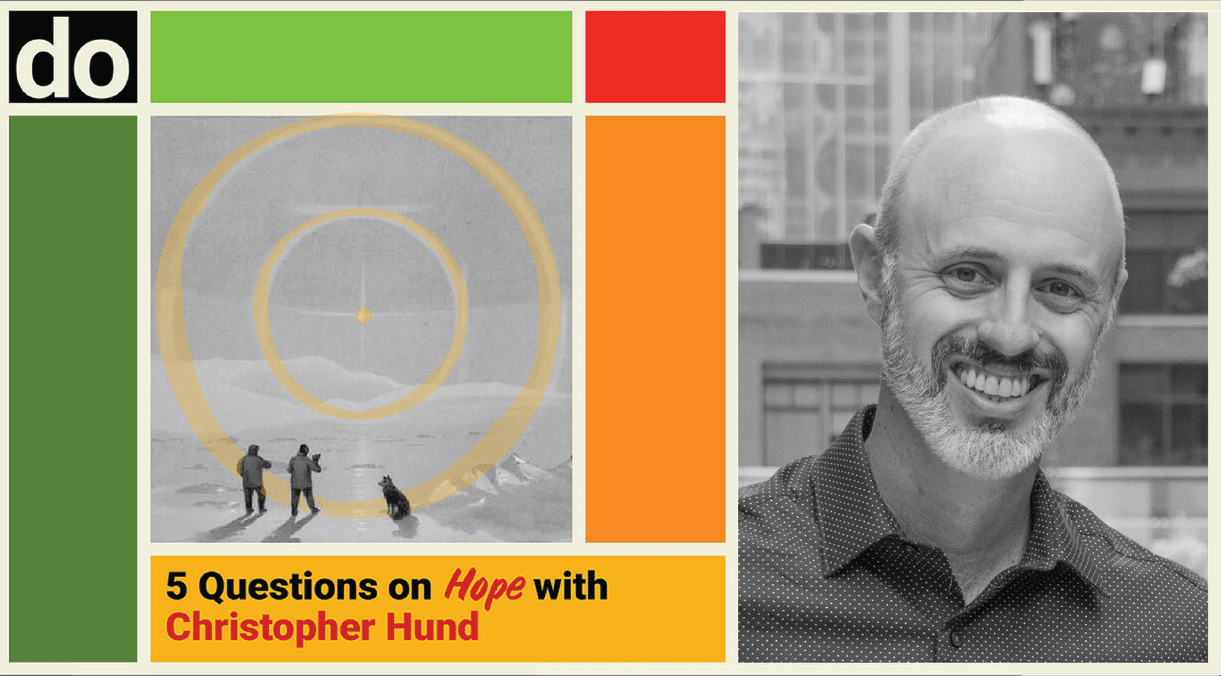
This interview is a part of our ongoing “5 Questions” series where we ask leaders, who we’ve had the pleasure of partnering with, about their work.
Christopher Hund is a powerful innovator. He’s the Midwest Executive Director at Aledade, Inc. the nation’s leading consultant in value-based care—plus, he’s a top-notch orator. Do Tank worked with Chris during his time at the American Hospital Association. His first car was a gray, featureless Elantra named Glados.
We spoke with Chris after his return flight to the suburbs of Chicago, touching on his current work, biggest challenges, and philosophy on hope.
Listen to the full podcast below, or continue on for a summary of our conversation.
What do you think is more effective: Community-centered, localized solutions or broader innovative strokes?
You need broader strokes to get things moving. In my line of work, broader strokes might mean some national innovation—i.e. something is launched. For example, back in the day, the federal government jumpstarted an accountable care organization as a new innovation. This gets the ball rolling, but you need community-centered, localized solutions to move the needle on anything.
You need broader strokes to get things moving. In my line of work, broader strokes might mean some national innovation—i.e. something is launched. For example, back in the day, the federal government jumpstarted an accountable care organization as a new innovation. This gets the ball rolling, but you need community-centered, localized solutions to move the needle on anything.
You need to meet people where they are to have success. You need to understand the problem they are personally trying to solve. Everyone might have the same issue on a macro level, but they need specialized solutions to meet their specific challenges within that big issue.
“You need to meet people where they are to succeed.”
At Aledade, we have tech solutions for getting information to doctors. On a basic level, we help doctors understand the population that they serve. We give them a 360-degree vision of that population with insights on how to care for that population better. How do I understand the population I’m serving better? That’s the big problem doctors have nationwide.
On a local level, you need to work closely with specific practices—understanding the workflows, personalities, and team members at play—because each office will have different resources. Some offices have a doctor, an office manager, and that’s it! Others might have layers of billers, coders, insurance experts, and a whole variety of support staff. You need to work within their issues to understand how to utilize the technology we provide. Communication is key.
You help healthcare teams solve wicked challenges. What’s one overlooked issue you see across the healthcare field?
The biggest problem is connecting people to the team and connecting the team to the bigger picture. I don’t think this only applies to healthcare. This is a problem in any industry. Despite people’s efforts, we’re still kind of siloed.
A doctor sees things one way based on their lived and educational experiences. A nurse sees things in a totally different way because of their experiences. The same goes for non-clinical staff like office managers, billers, and front desk people. All professionals, but they’re thinking about the job in an entirely different way. The biggest thing we can do is bring them together as a team.
Your team works to transform primary care in the Midwest. With a mission this important, why choose a design-thinking and common sense approach?
There are a few reasons. First off, design-thinking works in providing those local solutions because people can make decisions themselves. It’s about meeting people where they are. In my work with an Aledade, and my previous work with the American Hospital Association, everybody I talked to as a client or partner is not someone who works for us. With Aledade, we focus on keeping people independent. The idea is, “You’re a doctor, and we want you to be independent and have your own solutions.”
That’s what’s great about design thinking: We give someone the ability to develop independent solutions that work best for them.
It also gets people talking that don’t normally talk to each other. This approach generates empathy because you can understand how someone sees a problem and solves it according to their personality and profession. I think that’s important.
Design thinking is structured and actionable. Medical professionals don’t have time. They can’t just sit down and brainstorm. Medical professionals really only have 30 minutes—how will you approach the problem in 30 minutes? Design thinking is structured in a way that solves the time constraint.
Lastly, and it’s something that’s overlooked, design thinking is fun. People enjoy themselves doing this. People start laughing. Maybe they’re drawing a picture or interacting with a new concept, and they start to see each other in a different light. It’s really important to provide that too.
As innovators, we often use the phrase “changing the playbook” to represent our work. You’ve literally written playbooks as an editor for the AHA. Why is language such an important factor in design thinking?
The foundation of commonality is language. You need to call things by the same name. That helps you get on the same page, speak the same language, and have a shared mental model. This doesn’t just apply to those developing the playbook, but also when the playbook is out in the field. When you use the same language, new people can join the team much easier.
A unified playbook also stops slippage. If you’re calling something by one name, then people start using another language, and sooner or later, the whole thing falls apart. It seems rather strict and structured, especially after our discussion about meeting people where they are, but it’s extremely important to encourage people to call things by the same name.
What’s the most satisfying impact you’ve fostered as an executive director at Aledade?
There have been a few moments where some of the doctors we serve have said something like, “my life is better now.” I actually had one of our doctor’s daughters, whom I was interviewing for a role, say, “my mom is so much happier now.” That was cool to hear. An adult herself tells me her mom feels better because of our work.
We provide innovation and paths for doctors to stay independent, but more than anything—and it’s an unspoken thing—we provide hope that things are going to be better. That kind of hope brings resiliency. As I’m sure you know, Burnout and resilience are huge problems in healthcare. Doctors and the people in their offices are vital. We need them to stay independent because independent doctors often serve communities that don’t have access to healthcare or independent doctors just understand their communities better.
A unified playbook also stops slippage. If you’re calling something by one name, then people start using another language, and sooner or later, the whole thing falls apart. It seems rather strict and structured, especially after our discussion about meeting people where they are, but it’s extremely important to encourage people to call things by the same name.
“We provide hope that things are going to be better. The kind of hope that brings resiliency.”
We need those local doctors to stay independent, happy, and doing the job that they’re doing. I’m happy my team at Aledade can provide doctors with independence that leads to better processes and getting rewarded for what they do. It makes them happier to have those connections with their patients.
At Aledade, everything we do goes through a lens of: Does it make life better for the patient? Does it keep them out of the hospital? Does it prevent them from having unnecessary healthcare? Does it make life better for the doctor and teams connected to them?
Then, when it’s all said it done, we ask: Is what we’re doing right for society? Is this work helping the populations that they serve, and does it help to cut down on medical spending? It’s pretty special stuff to be able to do this. To help people find solutions that make their life, their communities’ lives, and the lives of their moms a little better.


